Tuesday, February 6, 2007

In the Beginning (Dylan Thomas )


Louvre 5
Originally uploaded by efra28.


In the beginning was the three-pointed star,
One smile of light across the empty face,
One bough of bone across the rooting air,
The substance forked that marrowed the first sun,
And, burning ciphers on the round of space,
Heaven and hell mixed as they spun.

In the beginning was the pale signature,
Three-syllabled and starry as the smile,
And after came the imprints on the water,
Stamp of the minted face upon the moon;
The blood that touched the crosstree and the grail
Touched the first cloud and left a sign.

In the beginning was the mounting fire
That set alight the weathers from a spark,
A three-eyed, red-eyed spark, blunt as a flower,
Life rose and spouted from the rolling seas,
Burst in the roots, pumped from the earth and rock
The secret oils that drive the grass.

In the beginning was the word, the word
That from the solid bases of the light
Abstracted all the letters of the void;
And from the cloudy bases of the breath
The word flowed up, translating to the heart
First characters of birth and death.

In the beginning was the secret brain.
The brain was celled and soldered in the thought
Before the pitch was forking to a sun;
Before the veins were shaking in their sieve,
Blood shot and scattered to the winds of light
The ribbed original of love.

Dylan Thomas

a total stranger (E.E. Cummings)


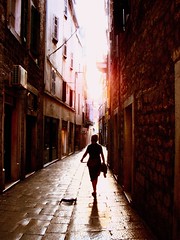
side alley at dusk
Originally uploaded by allysonk.

A total stranger one black day
knocked living the hell out of me

E.E. Cummings

Saturday, February 3, 2007

Immense et Rouge (Jacques Prévert)


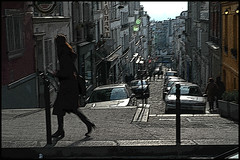
vue depuis la rue lepic
Originally uploaded by jam-L.

Immense et rouge
Au-dessus du Grand Palais
Le soleil d'hiver apparaît
Et disparaît
Comme lui mon coeur va disparaître
Et tout mon sang va s'en aller
S'en aller à ta recherche
Mon amour
Ma beauté
Et te trouver
Là où tu es.

Jacques Prévert

Le jardin (Jacques Prévert)


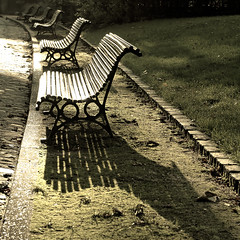
Silence
Originally uploaded by jam-L.


Des milliers et des milliers d'années
Ne sauraient suffire
Pour dire
La petite seconde d'éternité
Où tu m'as embrassé
Où je t'ai embrassèe
Un matin dans la lumière de l'hiver
Au parc Montsouris à Paris
A Paris
Sur la terre
La terre qui est un astre.

Jacques Prévert

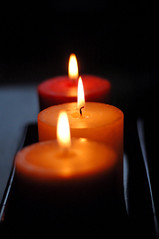
Candles (Sylvia Plath)


Originally uploaded by maxivida.


They are the last romantics, these candles:
Upside-down hearts of light tipping wax fingers,
And the fingers, taken in by their own haloes,
Grown milky, almost clear, like the bodies of saints.
It is touching, the way they'll ignore

A whole family of prominent objects
Simply to plumb the deeps of an eye
In its hollow of shadows, its fringe of reeds,
And the owner past thirty, no beauty at all.
Daylight would be more judicious,

Giving everybody a fair hearing.
They should have gone out with the balloon flights and the stereopticon.
This is no time for the private point of view.
When I light them, my nostrils prickle.
Their pale, tentative yellows

Drag up false, Edwardian sentiments,
And I remember my maternal grandmother from Vienna.
As a schoolgirl she gave roses to Franz Josef.
The burghers sweated and wept. The children wore white.
And my grandfather moped in the Tyrol,

Imagining himself a headwaiter in America,
Floating in a high-church hush
Among ice buckets, frosty napkins.
These little globes of light are sweet as pears.
Kindly with invalids and mawkish women,

They mollify the bald moon.
Nun-souled, they burn heavenward and never marry.
The eyes of the child I nurse are scarcely open.
In twenty years I shall be retrograde
As these drafty ephemerids.

I watch their spilt tears cloud and dull to pearls.
How shall I tell anything at all
To this infant still in a birth-drowse?
Tonight, like a shawl, the mild light enfolds her,
The shadows stoop over the guests at a christening.


by Sylvia Plath

Sylvia Plath Biography

Sylvia Plath (1932-1963)

Born to middle class parents in Jamaica Plain, Massachusetts, Sylvia Plath published her first poem when she was eight. Sensitive, intelligent, compelled toward perfection in everything she attempted, she was, on the surface, a model daughter, popular in school, earning straight A's, winning the best prizes. By the time she entered Smith College on a scholarship in 1950 she already had an impressive list of publications, and while at Smith she wrote over four hundred poems.

Sylvia's surface perfection was however underlain by grave personal discontinuities, some of which doubtless had their origin in the death of her father (he was a college professor and an expert on bees) when she was eight. During the summer following her junior year at Smith, having returned from a stay in New York City where she had been a student ``guest editor'' at Mademoiselle Magazine, Sylvia nearly succeeded in killing herself by swallowing sleeping pills. She later described this experience in an autobiographical novel, The Bell Jar, published in 1963. After a period of recovery involving electroshock and psychotherapy Sylvia resumed her pursuit of academic and literary success, graduating from Smith summa cum laude in 1955 and winning a Fulbright scholarship to study at Cambridge, England.

In 1956 she married the English poet Ted Hughes , and in 1960, when she was 28, her first book, The Colossus, was published in England. The poems in this book---formally precise, well wrought---show clearly the dedication with which Sylvia had served her apprenticeship; yet they give only glimpses of what was to come in the poems she would begin writing early in 1961. She and Ted Hughes settled for a while in an English country village in Devon, but less than two years after the birth of their first child the marriage broke apart.

The winter of 1962-63, one of the coldest in centuries, found Sylvia living in a small London flat, now with two children, ill with flu and low on money. The hardness of her life seemed to increase her need to write, and she often worked between four and eight in the morning, before the children woke, sometimes finishing a poem a day. In these last poems it is as if some deeper, powerful self has grabbed control; death is given a cruel physical allure and psychic pain becomes almost tactile.

On February 11, 1963, Sylvia Plath killed herself with cooking gas at the age of 30. Two years later Ariel, a collection of some of her last poems, was published; this was followed by Crossing the Water and Winter Trees in 1971, and, in 1981, The Collected Poems appeared, edited by Ted Hughes.

(after a bio by Bill Gilson)

Friday, February 2, 2007

A pretty a day (E. E. Cummings)


four from today: self portrait: daddy doing daddy's work
Originally uploaded by superNova K.


a pretty a day
(and every fades)
is here and away
(but born are maids
to flower an hour
in all,all)

o yes to flower
until so blithe
a doer a wooer
some limber and lithe
some very fine mower
a tall;tall

some jerry so very
(and nellie and fan)
some handsomest harry
(and sally and nan
they tremble and cower
so pale:pale)

for betty was born
to never say nay
but lucy could learn
and lily could pray
and fewer were shyer
than doll. doll

by E. E. Cummings

I carry your heart with me (E. E. Cummings)


Reflection
Originally uploaded by hefestus.

i carry your heart with me
i carry your heart with me(i carry it in
my heart)i am never without it(anywhere
i go you go,my dear; and whatever is done
by only me is your doing,my darling)
i fear
no fate(for you are my fate,my sweet)i want
no world(for beautiful you are my world,my true)
and it's you are whatever a moon has always meant
and whatever a sun will always sing is you

here is the deepest secret nobody knows
(here is the root of the root and the bud of the bud
and the sky of the sky of a tree called life;which grows
higher than the soul can hope or mind can hide)
and this is the wonder that's keeping the stars apart

i carry your heart(i carry it in my heart)

by E. E. Cummings

Always For The First Time (Andre Breton)


rendez-vous
Originally uploaded by nikoskrikelis.


Always for the first time
Hardly do I know you by sight
You return at some hour of the night to a house at an angle to my window
A wholly imaginary house
It is there that from one second to the next
In the inviolate darkness
I anticipate once more the fascinating rift occurring
The one and only rift
In the facade and in my heart
The closer I come to you
In reality
The more the key sings at the door of the unknown room
Where you appear alone before me
At first you coalesce entirely with the brightness
The elusive angle of a curtain
It's a field of jasmine I gazed upon at dawn on a road in the vicinity of Grasse
With the diagonal slant of its girls picking
Behind them the dark falling wing of the plants stripped bare
Before them a T-square of dazzling light
The curtain invisibly raised
In a frenzy all the flowers swarm back in
It is you at grips with that too long hour never dim enough until sleep
You as though you could be
The same except that I shall perhaps never meet you
You pretend not to know I am watching you
Marvelously I am no longer sure you know
You idleness brings tears to my eyes
A swarm of interpretations surrounds each of your gestures
It's a honeydew hunt
There are rocking chairs on a deck there are branches that may well scratch you in the
forest
There are in a shop window in the rue Notre-Dame-de-Lorette
Two lovely crossed legs caught in long stockings
Flaring out in the center of a great white clover
There is a silken ladder rolled out over the ivy
There is
By my leaning over the precipice
Of your presence and your absence in hopeless fusion
My finding the secret
Of loving you
Always for the first time

by Andre Breton

Wednesday, January 31, 2007

Love Calls You By Your Name (Leonard Cohen)


Human B e h a v i o u r - II
Originally uploaded by fabikinhas_world.

You thought that it could never happen
to all the people that you became,
your body lost in legend, the beast so very tame.
But here, right here,
between the birthmark and the stain,
between the ocean and your open vein,
between the snowman and the rain,
once again, once again,
love calls you by your name.
The women in your scrapbook
whom you still praise and blame,
you say they chained you to your fingernails
and you climb the halls of fame.
Oh but here, right here,
between the peanuts and the cage,
between the darkness and the stage,
between the hour and the age,
once again, once again,
love calls you by your name.

Shouldering your loneliness
like a gun that you will not learn to aim,
you stumble into this movie house,
then you climb, you climb into the frame.
Yes, and here, right here
between the moonlight and the lane,
between the tunnel and the train,
between the victim and his stain,
once again, once again,
love calls you by your name.

I leave the lady meditating
on the very love which I, I do not wish to claim,
I journey down the hundred steps,
but the street is still the very same.
And here, right here,
between the dancer and his cane,
between the sailboat and the drain,
between the newsreel and your tiny pain,
once again, once again,
love calls you by your name.

Where are you, Judy, where are you, Anne?
Where are the paths your heroes came?
Wondering out loud as the bandage pulls away,
was I, was I only limping, was I really lame?
Oh here, come over here,
between the windmill and the grain,
between the sundial and the chain,
between the traitor and her pain,
once again, once again,
love calls you by your name.

Leonard Cohen

Last Year's Man (Leonard Cohen)

Leonard Cohen
The rain falls down on last year's man,
that's a jew's harp on the table,
that's a crayon in his hand.
And the corners of the blueprint are ruined since they rolled
far past the stems of thumbtacks
that still throw shadows on the wood.
And the skylight is like skin for a drum I'll never mend
and all the rain falls down amen
on the works of last year's man.
I met a lady, she was playing with her soldiers in the dark
oh one by one she had to tell them
that her name was Joan of Arc.
I was in that army, yes I stayed a little while;
I want to thank you, Joan of Arc,
for treating me so well.
And though I wear a uniform I was not born to fight;
all these wounded boys you lie beside,
goodnight, my friends, goodnight.

I came upon a wedding that old families had contrived;
Bethlehem the bridegroom,
Babylon the bride.
Great Babylon was naked, oh she stood there trembling for me,
and Bethlehem inflamed us both
like the shy one at some orgy.
And when we fell together all our flesh was like a veil
that I had to draw aside to see
the serpent eat its tail.

Some women wait for Jesus, and some women wait for Cain
so I hang upon my altar
and I hoist my axe again.
And I take the one who finds me back to where it all began
when Jesus was the honeymoon
and Cain was just the man.
And we read from pleasant Bibles that are bound in blood and skin
that the wilderness is gathering
all its children back again.

The rain falls down on last year's man,
an hour has gone by
and he has not moved his hand.
But everything will happen if he only gives the word;
the lovers will rise up
and the mountains touch the ground.
But the skylight is like skin for a drum I'll never mend
and all the rain falls down amen
on the works of last year's man.

Leonard Cohen

Stranger Song (Leonard Cohen)


interupted
Originally uploaded by anhtu.

It's true that all the men you knew were dealers
who said they were through with dealing
Every time you gave them shelter
I know that kind of man
It's hard to hold the hand of anyone
who is reaching for the sky just to surrender,
who is reaching for the sky just to surrender.
And then sweeping up the jokers that he left behind
you find he did not leave you very much
not even laughter
Like any dealer he was watching for the card
that is so high and wild
he'll never need to deal another
He was just some Joseph looking for a manger

And then leaning on your window sill
he'll say one day you caused his will
to weaken with your love and warmth and shelter
And then taking from his wallet
an old schedule of trains, he'll say
I told you when I came I was a stranger
I told you when I came I was a stranger.

But now another stranger seems
to want you to ignore his dreams
as though they were the burden of some other
O you've seen that man before
his golden arm dispatching cards
but now it's rusted from the elbows to the finger
And he wants to trade the game he plays for shelter
Yes he wants to trade the game he knows for shelter.

Ah you hate to see another tired man
lay down his hand
like he was giving up the holy game of poker
And while he talks his dreams to sleep
you notice there's a highway
that is curling up like smoke above his shoulder.
It is curling just like smoke above his shoulder.

You tell him to come in sit down
but something makes you turn around
The door is open you can't close your shelter
You try the handle of the road
It opens do not be afraid
It's you my love, you who are the stranger
It's you my love, you who are the stranger.

Well, I've been waiting, I was sure
we'd meet between the trains we're waiting for
I think it's time to board another
Please understand, I never had a secret chart
to get me to the heart of this
or any other matter
When he talks like this
you don't know what he's after
When he speaks like this,
you don't know what he's after.

Let's meet tomorrow if you choose
upon the shore, beneath the bridge
that they are building on some endless river
Then he leaves the platform
for the sleeping car that's warm
You realize, he's only advertising one more shelter
And it comes to you, he never was a stranger
And you say ok the bridge or someplace later.

And then sweeping up the jokers that he left behind ...

And leaning on your window sill ...

I told you when I came I was a stranger.

Leonard Cohen

Fare Well (Federico García Lorca)


Take this longing ....
Originally uploaded by hefestus.


If I die,
leave the balcony open.

The little boy is eating oranges.
(From my balcony I can see him.)

The reaper is harvesting the wheat.
(From my balcony I can hear him.)

If I die,
leave the balcony open!

Federico García Lorca

A Life (Sylvia Plath)


Luna de nieve/snow moon
Originally uploaded by Molotovio.


Touch it: it won't shrink like an eyeball,
This egg-shaped bailiwick, clear as a tear.
Here's yesterday, last year ---
Palm-spear and lily distinct as flora in the vast
Windless threadwork of a tapestry.

Flick the glass with your fingernail:
It will ping like a Chinese chime in the slightest air stir
Though nobody in there looks up or bothers to answer.
The inhabitants are light as cork,
Every one of them permanently busy.

At their feet, the sea waves bow in single file.
Never trespassing in bad temper:
Stalling in midair,
Short-reined, pawing like paradeground horses.
Overhead, the clouds sit tasseled and fancy

As Victorian cushions. This family
Of valentine faces might please a collector:
They ring true, like good china.

Elsewhere the landscape is more frank.
The light falls without letup, blindingly.

A woman is dragging her shadow in a circle
About a bald hospital saucer.
It resembles the moon, or a sheet of blank paper
And appears to have suffered a sort of private blitzkrieg.
She lives quietly

With no attachments, like a foetus in a bottle,
The obsolete house, the sea, flattened to a picture
She has one too many dimensions to enter.
Grief and anger, exorcised,
Leave her alone now.

The future is a grey seagull
Tattling in its cat-voice of departure.
Age and terror, like nurses, attend her,
And a drowned man, complaining of the great cold,
Crawls up out of the sea.


Sylvia Plath

Skater (Ted Kooser)


Two more ice skaters
Originally uploaded by Samuel K.


She was all in black but for a yellow pony tail
that trailed from her cap, and bright blue gloves
that she held out wide, the feathery fingers spread,
as surely she stepped, click-clack, onto the frozen
top of the world. And there, with a clatter of blades,
she began to braid a loose path that broadened
into a meadow of curls. Across the ice she swooped
and then turned back and, halfway, bent her legs
and leapt into the air the way a crane leaps, blue gloves
lifting her lightly, and turned a snappy half-turn
there in the wind before coming down, arms wide,
skating backward right out of that moment, smiling back
at the woman she'd been just an instant before.

Ted Kooser

Carrie (Ted Kooser)


Blue. Light.
Originally uploaded by James Rye.


"There's never an end to dust
and dusting," my aunt would say
as her rag, like a thunderhead,
scudded across the yellow oak
of her little house. There she lived
seventy years with a ball
of compulsion closed in her fist,
and an elbow that creaked and popped
like a branch in a storm. Now dust
is her hands and dust her heart.
There's never an end to it.

Ted Kooser

Tuesday, January 30, 2007

Barbara (Jacques Prévert)


BREST RAIN
Originally uploaded by East eneko.


Rappelle-toi Barbara
Il pleuvait sans cesse sur Brest ce jour-là
Et tu marchais souriante
Épanouie ravie ruisselante
Sous la pluie
Rappelle-toi Barbara
Il pleuvait sans cesse sur Brest
Et je t'ai croisée rue de Siam
Tu souriais
Et moi je souriais de même
Rappelle-toi Barbara
Toi que je ne connaissais pas
Toi qui ne me connaissais pas
Rappelle-toi
Rappelle-toi quand même jour-là
N'oublie pas
Un homme sous un porche s'abritait
Et il a crié ton nom
Barbara
Et tu as couru vers lui sous la pluie
Ruisselante ravie épanouie
Et tu t'es jetée dans ses bras
Rappelle-toi cela Barbara
Et ne m'en veux pas si je te tutoie
Je dis tu à tous ceux que j'aime
Même si je ne les ai vus qu'une seule fois
Je dis tu à tous ceux qui s'aiment
Même si je ne les connais pas
Rappelle-toi Barbara
N'oublie pas
Cette pluie sage et heureuse
Sur ton visage heureux
Sur cette ville heureuse
Cette pluie sur la mer
Sur l'arsenal
Sur le bateau d'Ouessant
Oh Barbara
Quelle connerie la guerre
Qu'es-tu devenue maintenant
Sous cette pluie de fer
De feu d'acier de sang
Et celui qui te serrait dans ses bras
Amoureusement
Est-il mort disparu ou bien encore vivant
Oh Barbara
Il pleut sans cesse sur Brest
Comme il pleuvait avant
Mais ce n'est plus pareil et tout est abimé
C'est une pluie de deuil terrible et désolée
Ce n'est même plus l'orage
De fer d'acier de sang
Tout simplement des nuages
Qui crèvent comme des chiens
Des chiens qui disparaissent
Au fil de l'eau sur Brest
Et vont pourrir au loin
Au loin très loin de Brest
Dont il ne reste rien.

Jacques Prévert

Alicante (Jacques Prévert)


Alicante_Fischer
Originally uploaded by Thinkabout.


Une orange sur la table
Ta robe sur le tapis
Et toi dans mon lit
Doux présent du présent
Fraîcheur de la nuit
Chaleur de ma vie.

Jacques Prévert

Les feuilles mortes (Jacques Prévert)


At the Jardin de Luxenburg
Originally uploaded by hefestus.

Les feuilles mortes

C'est une chanson, qui nous ressemble
Toi tu m'aimais et je t'aimais
Nous vivions tous, les deux ensemble
Toi que m'aimais moi qui t'aimais
Mais la vie sépare ceux qui s'aiment
Tout doucement sans faire de bruit
Et la mer efface sur la sable les pas des amants désunis

Oh! je voudrais tant que tu te souviennes
Des jours heureux oů nous étions amis
En ce temps-la la vie était plus belle,
Et le soleil plus brűlant qu'aujourd'hui
Les feuilles mortes se ramassent a la pelle
Tu vois, je n'ai pas oublié...
Les feuilles mortes se ramassent a la pelle,
Les souvenirs et les regrets aussi
Et le vent du nord les emporte
Dans la nuit froide de l'oubli.
Tu vois, je n'ai pas oublié
La chanson que tu me chantais.

C'est une chanson qui nous ressemble
Toi, tu m'aimais et je t'aimais
Et nous vivions tous deux ensemble
Toi qui m'aimais, moi qui t'aimais
Mais la vie sépare ceux qui s'aiment
Tout doucement, sans faire de bruit
Et la mer efface sur le sable
Les pas des amants désunis.

Les feuilles mortes se ramassent a la pelle,
Les souvenirs et les regrets aussi
Mais mon amour silencieux et fidele
Sourit toujours et remercie la vie
Je t'aimais tant, tu étais si jolie,
Comment veux-tu que je t'oublie?
En ce temps-la, la vie était plus belle
Et le soleil plus brűlant qu'aujourd'hui
Tu étais ma plus douce amie
Mais je n'ai que faire des regrets
Et la chanson que tu chantais
Toujours, toujours je l'entendrai!

C'est une chanson qui nous ressemble
Toi, tu m'aimais et je t'aimais
Et nous vivions tous deux ensemble
Toi qui m'aimais, moi qui t'aimais
Mais la vie sépare ceux qui s'aiment
Tout doucement, sans faire de bruit
Et la mer efface sur le sable
Les pas des amants désunis.

(musique: Joseph Kosma, paroles: Jacques Prévert, interprete pour la premiere fois par Yves Montand en 1946)

Jacques Prévert

Chanson pour les enfants l’hiver (Jacques Prévert)


Paris Jardin de Luxenbourg
Originally uploaded by hefestus.


Dans la nuit de l’hiver galope un grand homme blanc.
C’est un bonhomme de neige avec une pipe en bois,
un grand bonhomme de neige poursuivi par le froid.


Il arrive au village.
Voyant de la lumière,
le voilà rassuré.

Dans une petite maison, il entre sans frapper
et pour se réchauffer
s’assoit sur le poêle rouge
et d’un coup disparaît,
ne laissant que sa pipe au milieu d’une flaque d’eau,
ne laissant que sa pipe et puis son vieux chapeau...

Jacques Prévert